
Automated rollback shortens the time between production degradation and recovery, but speed alone does not make it safe. A poorly designed policy can react to noisy telemetry, reverse a healthy release, corrupt data, overload a dependency, or oscillate between versions. The policy must know what evidence to trust, when automation is allowed, which systems move together, and how health will be proved afterward.
Treat rollback as a production control system rather than a deployment command. Inputs include release context and live health. The decision has explicit thresholds and confidence requirements. Outputs contain exposure, restore compatible state, and preserve evidence for review.
Define what rollback means for the change
For a stateless service, rollback may mean restoring the previous image. For a distributed release, it may also require shifting traffic, disabling a feature flag, restoring configuration, pausing consumers, invalidating caches, or applying a forward database repair. Define the recovery unit before writing a trigger.
Record the last known-good versions of every participating component and the compatibility window between them. Identify irreversible operations, messages written in a new format, schema changes, security policy changes, and external side effects. When an action cannot be reversed automatically, the policy should contain exposure and escalate instead of pretending a full rollback exists.
Safety principle: automate only the recovery actions whose preconditions can be checked and whose outcome can be verified.
Use a portfolio of health signals
Single-metric triggers are fragile. Error rate can rise because of an upstream outage; latency can change with traffic mix; a business metric can arrive too slowly for initial containment. Combine signals at different layers and compare the exposed cohort with a stable baseline.
- Release mechanics: failed instances, crash loops, readiness failures, unhealthy targets, and deployment timeout.
- Service health: errors, latency, saturation, queue growth, retry volume, and dependency failures.
- Data health: migration errors, constraint failures, replication lag, reconciliation drift, and unexpected write patterns.
- Customer outcomes: login, checkout, payment, activation, search, or other critical journey success.
Require signal freshness and minimum sample size. Mark missing telemetry as unknown, not healthy. Use burn-rate or sustained-window logic to avoid reacting to one transient spike, while retaining immediate stop conditions for catastrophic failures such as data corruption or authentication loss.
Design deterministic decision logic
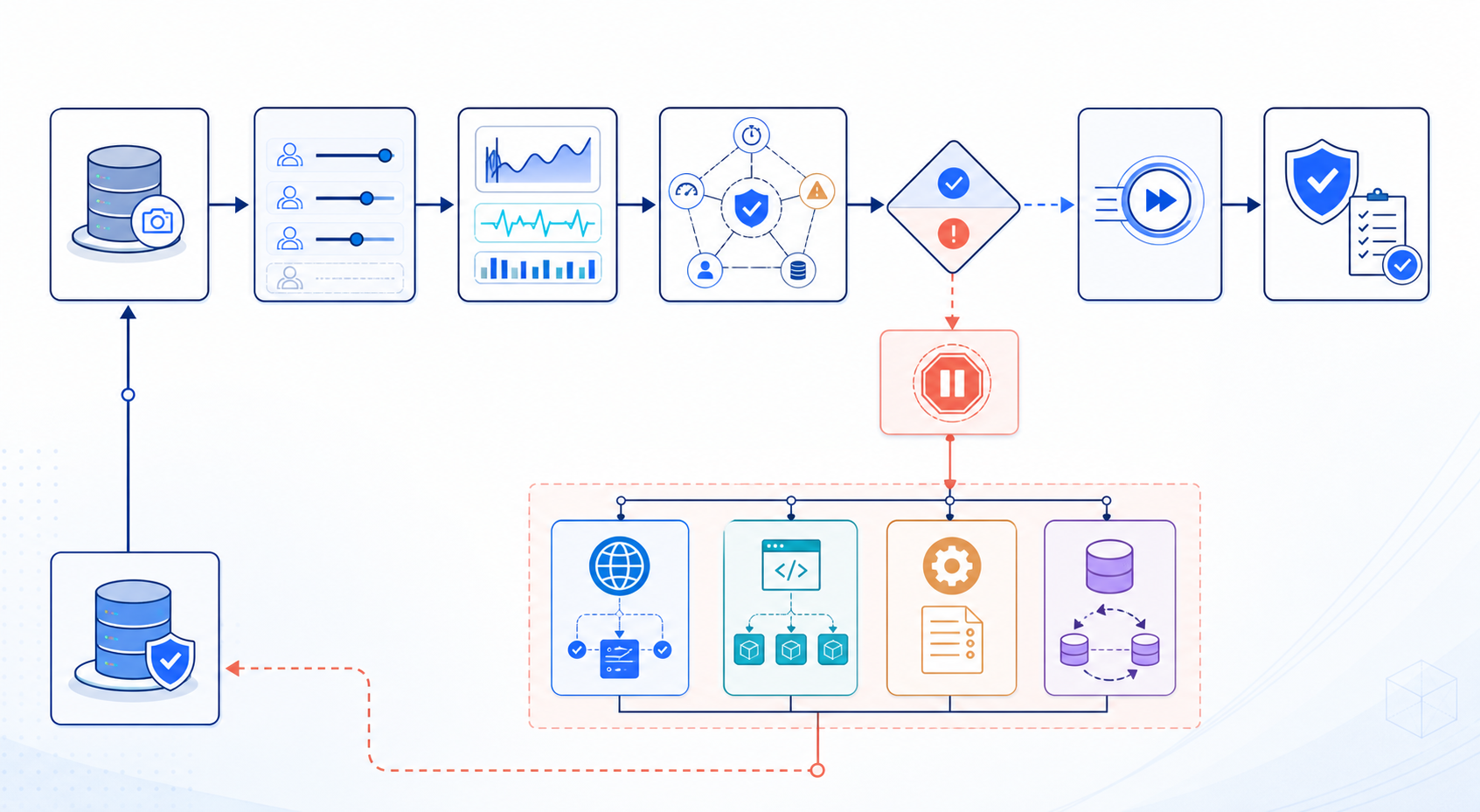
Separate three actions: pause further exposure, initiate rollback, and request human intervention. Pausing is low-cost and can happen on weaker evidence. Rollback should require stronger evidence that the release is causal and that recovery is eligible. Human review covers ambiguous or irreversible conditions.
A policy can use two windows: a fast window for sharp regression and a slower window for sustained degradation. Compare the canary with the baseline, account for known incidents, and require agreement across independent signals where possible. Apply hysteresis so the system does not repeatedly switch states around a threshold.
Check rollback eligibility at decision time
Conditions can change after a release begins. Before execution, confirm that the previous artifact and configuration are available, the environment still matches the expected state, no conflicting deployment is running, the schema remains backward compatible, the rollback is inside its allowed window, and required permissions are valid.
Use policy locks to prevent simultaneous recovery workflows from different tools. Assign one recovery coordinator and one durable change identifier. For shared resources, check whether rolling back one service would break another service that has already adopted the new contract.
Coordinate recovery actions in the right order
- Freeze exposure: stop rollout expansion and block new changes to the affected scope.
- Contain impact: shift traffic, disable a flag, isolate a region, or pause consumers.
- Restore compatible state: deploy the previous artifact and configuration or execute the approved forward repair.
- Stabilize dependencies: drain queues, restore routing, warm caches, and confirm downstream compatibility.
- Verify: compare technical and customer health with the pre-release baseline.
Every action needs a timeout, retry policy, idempotency expectation, and failure branch. If a recovery step fails, automation should stop at a known state and provide responders with the completed actions, remaining actions, and current evidence.
Prove that recovery worked
A successful command is not a successful rollback. Wait for capacity and traffic to stabilize, then evaluate the same signals that triggered the policy plus recovery-specific checks. Confirm version convergence, configuration state, schema compatibility, queue behavior, data integrity, and critical customer journeys.
Keep the change frozen until the minimum verification window completes. If health remains degraded, the original release may not be causal or recovery may be incomplete. Escalate with a compact evidence bundle rather than repeatedly attempting the same action.
Test and improve the policy
Exercise rollback in a production-like environment for each change class. Inject realistic signal failures, stale telemetry, partial deployment, missing artifacts, permission loss, and dependency degradation. Run game days that verify the boundary between automation and human response.
Track false triggers, missed regressions, time to pause, time to recover, incomplete actions, verification time, and manual overrides. Review every automated rollback as a policy test. Adjust thresholds with versioned changes and replay them against historical telemetry before promotion.
The objective is not to maximize the number of automatic rollbacks. It is to reduce customer exposure when evidence is strong and recovery is genuinely safer than continuation. A bounded policy that sometimes pauses and asks for a person is more mature than automation that always acts.