
A release readiness checklist is a decision aid, not a ceremony. It should expose missing information while there is still time to act and help a team make a clear go, hold, or revise decision. A long form completed from memory minutes before deployment cannot do that. An effective checklist is short enough to use, connected to live evidence, and proportional to the change.
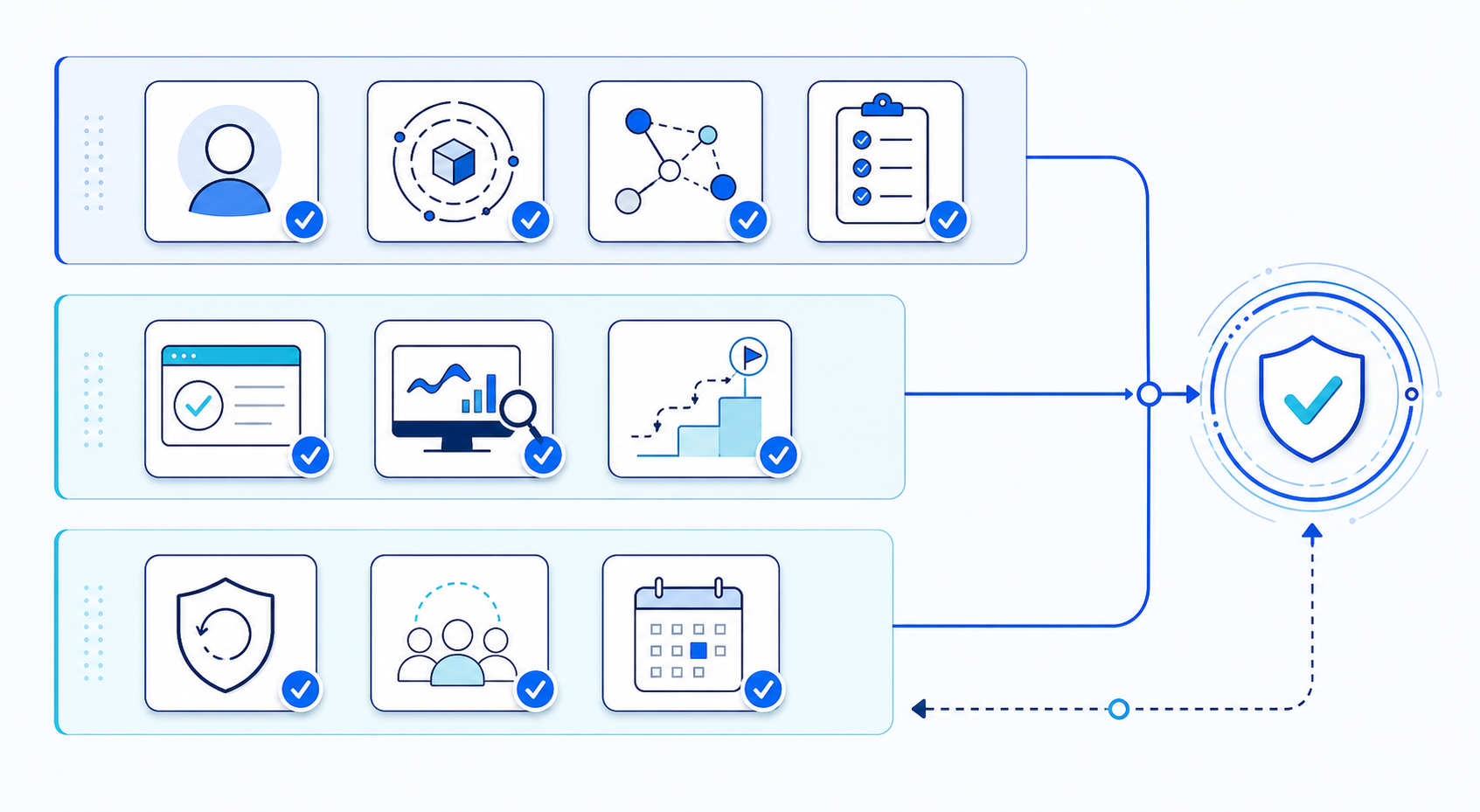
The best readiness reviews begin before the deployment window. Ownership, dependency context, test evidence, observability, rollout controls, customer exposure, and recovery plans should accumulate as the change moves toward production. The final review then confirms evidence instead of searching for it.
Define what “ready” means
Ready does not mean risk-free. It means the remaining risk is understood, accepted by the right owner, and controlled by a release plan that can detect and contain an unacceptable outcome. A team should be able to answer four questions without interpretation:
- What production behavior or state will change?
- Which systems and customers can be exposed at each stage?
- Which signals prove that the change is healthy?
- What exact action stops exposure and restores a safe state?
Readiness rule: if a check cannot identify the evidence it protects or the decision it changes, remove it or rewrite it.
1. Establish complete change context
Confirm ownership and intent
Name one accountable release owner and one technical responder. Record the intended customer or operational outcome, the changed services and resources, the target environments, the rollout window, and every related change that must move with it. Ownership must remain clear after normal working hours and during handoffs.
Describe the real change set
Application artifacts are only one part of production change. Include database migrations, infrastructure plans, configuration, secrets, IAM policies, traffic rules, scheduled jobs, queues, feature flags, and vendor changes. A safe application rollback may not reverse a schema or permission change made alongside it.
Map dependencies and customer exposure
Identify critical upstream callers, downstream services, shared data stores, asynchronous consumers, third-party dependencies, regions, tenants, and revenue flows. Note whether a dependency can amplify load or retain an incompatible message after rollback. Translate technical scope into the customers or business processes that could experience it.
2. Verify the evidence, not the checkbox
Tests should match the changed behavior and failure mode. Link unit, integration, contract, migration, performance, and security evidence where they are relevant. Record known gaps explicitly; a green pipeline should not hide that an important path has no representative test.
Before rollout, confirm that production telemetry is present and stable enough to judge the change. Define baselines and thresholds for error rate, latency, saturation, queue depth, data consistency, and critical business outcomes. Assign a source and owner to each signal. Missing or delayed telemetry should have a stop rule of its own.
Check operating conditions
Compare the change window with expected traffic, business events, staffing, maintenance work, freezes, and other production changes. A technically safe deployment can become risky when it overlaps a marketing launch, financial close, regional holiday, cloud maintenance, or a second change to the same dependency.
3. Design exposure as a sequence
Replace a single production launch with explicit stages. A typical sequence may include internal traffic, one low-risk tenant, one region, a small percentage, and broader availability. Define who or what enters each stage, how long observation lasts, the maximum exposure, and the evidence required to continue.
Every stage needs three outcomes: advance, hold, or recover. “Wait and see” is not a fourth outcome. If a signal is ambiguous, holding exposure should be a normal, low-friction decision while the owner investigates.
- Set minimum observation periods that match traffic and failure latency.
- Use both service-level and customer-level health measures.
- Prevent manual expansion when a required signal is unavailable.
- Record who can override a gate and when the override expires.
4. Prove recovery readiness
“Rollback available” is not enough. Name the trigger, the decision owner, the actions, the expected duration, and the validation steps. Determine whether recovery means artifact rollback, traffic shift, flag disablement, configuration restore, queue pause, data repair, or a coordinated combination.
Check backward compatibility across databases, messages, APIs, and caches. Preserve the previous artifact and configuration. Test the recovery path for the change class, not merely for an unrelated past release. If data cannot be reversed, prepare a forward repair and define the maximum tolerable inconsistency window.
5. Make the go, hold, or revise decision
A final readiness decision should identify unresolved evidence and its owner. A medium or high-risk change may still proceed when the exposure is narrow, detection is strong, recovery is rehearsed, and the accountable owner accepts the residual risk. A low-scored change should still be held when a mandatory signal or recovery step is missing.
Record the decision, timestamp, evidence links, policy results, exceptions, and people involved. Do not copy sensitive data into the record; preserve stable references to the source systems. After completion, add the release outcome, customer impact, recovery actions, and follow-up items.
Turn the checklist into a living control
- Start with the failure modes from recent incidents and map each one to a readiness question.
- Automate facts from source control, CI/CD, cloud, observability, databases, and ownership catalogs.
- Use conditional checks so database, infrastructure, permission, and flag changes receive appropriate questions.
- Measure which missing checks actually delay, stop, or improve releases.
- Review the checklist quarterly and remove controls that no longer change decisions.
A readiness checklist earns trust when it makes the next decision easier. It should show what the team knows, what remains uncertain, how much production is exposed, and how quickly the system can return to safety. That is a stronger definition of ready than a page of completed boxes.