
A failed deployment incident is not limited to a red pipeline. The deployment may complete successfully while customers experience elevated errors, stale data, missing permissions, queue growth, or a broken dependency contract. Treat the production outcome as the source of truth.
The response should reduce customer impact without destroying the evidence needed to understand the failure. A clear change timeline, known deployment scope, and rehearsed recovery controls turn an uncertain outage into a bounded engineering decision.
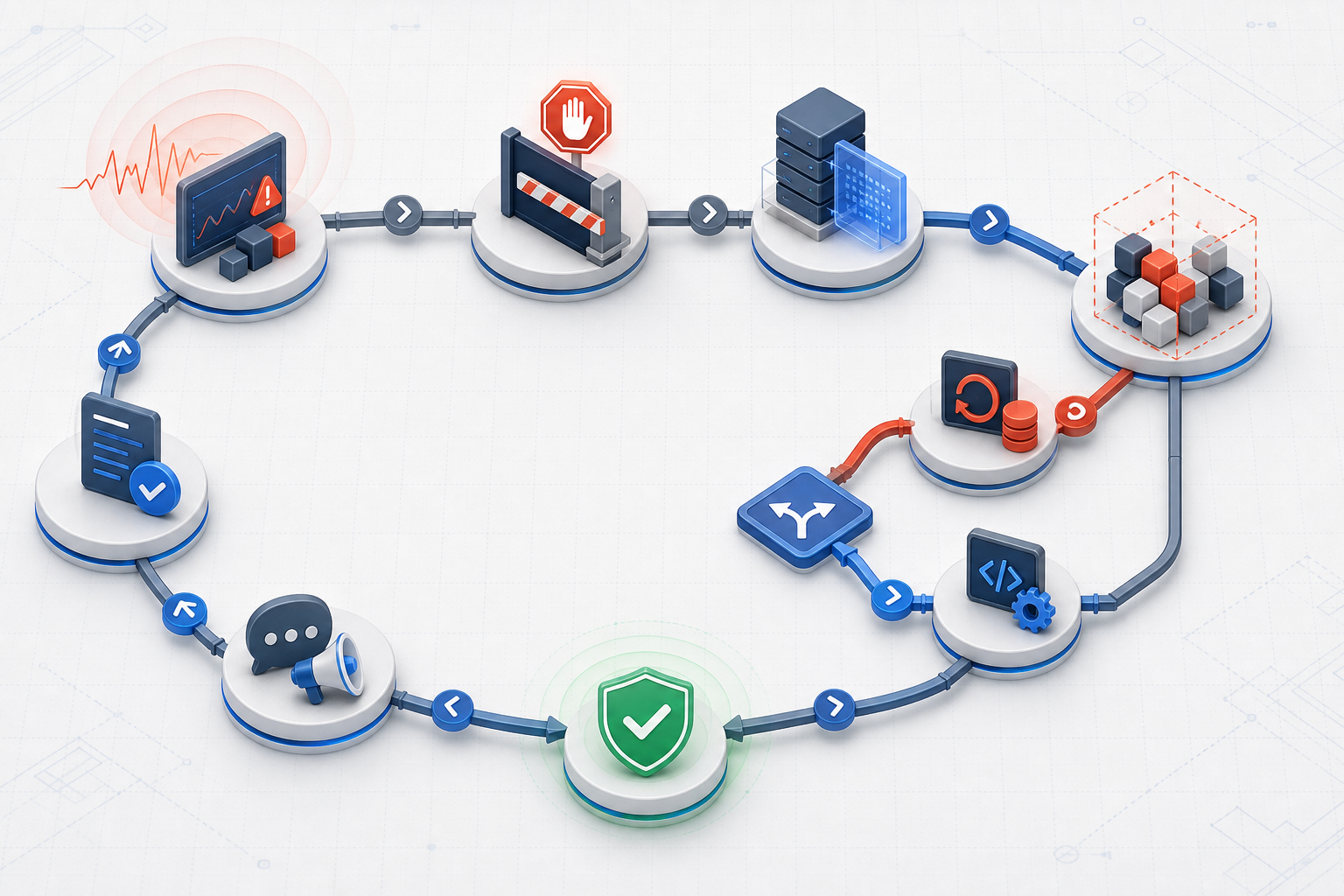
Declare the incident and stabilize the release path
Pause further rollout as soon as a credible production regression appears. Stop automated expansion, freeze related changes, and prevent retries from increasing exposure. If the delivery platform cannot pause safely, remove traffic from the affected cohort or isolate the changed component through another tested control.
Name an incident commander and a technical recovery owner. The commander protects focus, coordinates communication, and tracks decisions; the recovery owner evaluates the change and executes the selected path. Add service, database, infrastructure, security, and customer specialists according to the affected dependency graph.
First principle: do not wait for perfect diagnosis before containing a change that is still spreading customer impact.
- Record the detection time and the first known customer symptom.
- Pause deployment controllers, progressive delivery, and concurrent migrations.
- Confirm the last healthy stage, version, region, and cohort.
- Open a shared incident timeline and assign decision ownership.
Establish the actual blast radius
Compare intended deployment scope with observed exposure. The release plan may say five percent while retries, routing, autoscaling, or manual actions placed the version elsewhere. Query the running artifact and configuration by service, cluster, region, account, tenant, and availability zone.
Map downstream and upstream dependencies. A change in authentication can affect every product surface; a database migration can impact old application versions; an infrastructure policy can block background jobs that do not appear in request latency. Include customer segments, internal operators, integrations, batch workloads, and data pipelines.
Use a concise scope statement that is updated as evidence improves: affected versions, environments, regions, services, customers, symptoms, and the confidence level. Distinguish confirmed impact from suspected exposure so recovery is neither too narrow nor unnecessarily broad.
Preserve evidence before changing the system again
Capture the source revision, artifact digest, configuration, feature flags, infrastructure plan, migration version, deployment events, approval record, actor identities, and routing state. Mark the relevant telemetry window and retain representative logs and traces. Avoid bulk copying sensitive production data into the incident channel.
Build a minute-by-minute change timeline that includes concurrent releases and automated actions. The most recent deployment may correlate with detection but not cause the incident. An expired credential, capacity event, dependency release, or earlier data change may be involved.
Evidence collection should be automated in normal delivery. During an incident, engineers should retrieve one connected change record instead of signing into six systems and reconciling timestamps manually.
Choose rollback, roll forward, or isolation
Rollback is usually attractive because it returns to known code, but it is safe only when prior application and data states remain compatible. A database migration, asynchronous event, external side effect, or irreversible infrastructure operation can make a binary rollback incomplete or harmful.
A forward fix may be faster when the defect is understood, the patch is small, and rollback cannot restore state. It also introduces new code under pressure. Isolation may be best when one region, tenant cohort, feature, or dependency can be removed from traffic while the team investigates.
- Rollback when: the prior artifact is compatible, available, tested, and likely to restore the failing path.
- Forward-fix when: root cause is high confidence, the repair is minimal, and rollback would not recover data or contracts.
- Isolate when: the affected scope can be removed without overloading healthy capacity or violating data assumptions.
- Fail over when: the destination is healthy, compatible, sufficiently current, and able to absorb load.
Set a time box for the decision. Endless diagnosis while customers remain exposed is itself a decision. Record the selected action, rejected alternatives, owner, assumptions, and stop conditions.
Execute recovery as another controlled change
Recovery needs a plan, scope, owner, and observation gates. Begin with the smallest action that can materially reduce impact. Confirm that the command targets the affected environment, preserve the current state for comparison, and keep a second recovery option available.
- Announce the selected recovery action and expected signal of success.
- Apply it to a bounded cohort or one failure domain when architecture allows.
- Observe technical health and critical customer transactions.
- Expand recovery only while those signals improve.
- Stop and reassess if symptoms move, new failures appear, or assumptions prove false.
Coordinate data recovery separately from application rollback. Restore or replay only with a defined recovery point, integrity checks, and business approval for potential loss. If queues accumulated during containment, control replay rate so recovery traffic does not trigger a second outage.
Prove recovery instead of trusting a green status
A completed rollback job proves execution, not recovery. Verify customer-facing transactions, regional health, dependency behavior, database consistency, queue depth, replication, and support signals. Compare against the pre-incident baseline and observe long enough to include delayed work.
Confirm the running version and configuration across the full affected scope. Partial rollback is common when one cluster, function alias, cache, or scheduled job remains on the failed state. Check that temporary routing and feature controls behave as intended.
Declare mitigation when customer impact is controlled; declare resolution only when the system is stable, hidden backlogs are understood, and monitoring can detect recurrence. Record any degraded mode or manual follow-up explicitly.
Communicate facts, decisions, and uncertainty
Internal updates should state impact, scope, current action, evidence, risk, owner, and next update time. Avoid a stream of raw logs. External communication should focus on customer effect and restoration progress without unsupported cause claims.
Use timestamps with an explicit timezone. Preserve corrections instead of silently editing the timeline. When confidence is limited, say what is confirmed, what is suspected, and what the team is doing to distinguish them.
Close the loop after service is stable
Link the incident to the deployment record and preserve the final impact window, causal change, contributing conditions, recovery actions, and verification evidence. Review why pre-production testing, risk analysis, rollout gates, or monitoring did not prevent or detect the problem sooner.
Prefer durable control improvements over reminders to “be careful.” Examples include smaller initial cohorts, customer-level comparison, schema compatibility checks, automated pause thresholds, tested rollback workflows, dependency ownership, and required evidence fields.
- Update runbooks with the commands and conditions that actually worked.
- Exercise recovery in a realistic environment and measure time to safe state.
- Track corrective actions to an owner and completion signal.
- Feed incident findings back into transparent deployment risk inputs.
Effective incident response is not simply fast rollback. It is the ability to contain exposure, make a defensible decision from production context, execute recovery safely, and prove that customers are healthy again.