
Deployment evidence is usually scattered across source control, work tracking, CI logs, cloud activity, chat approvals, observability, and incident tooling. Each system contains a partial truth. During an audit or outage, engineers spend valuable time reconstructing a release from timestamps and assumptions.
A deployment audit trail solves that reconstruction problem by assigning one durable identity to the production change and attaching every relevant decision and event to it. The result should answer what changed, why it changed, who or what authorized it, where it ran, which controls passed, what customers experienced, and how the system recovered.
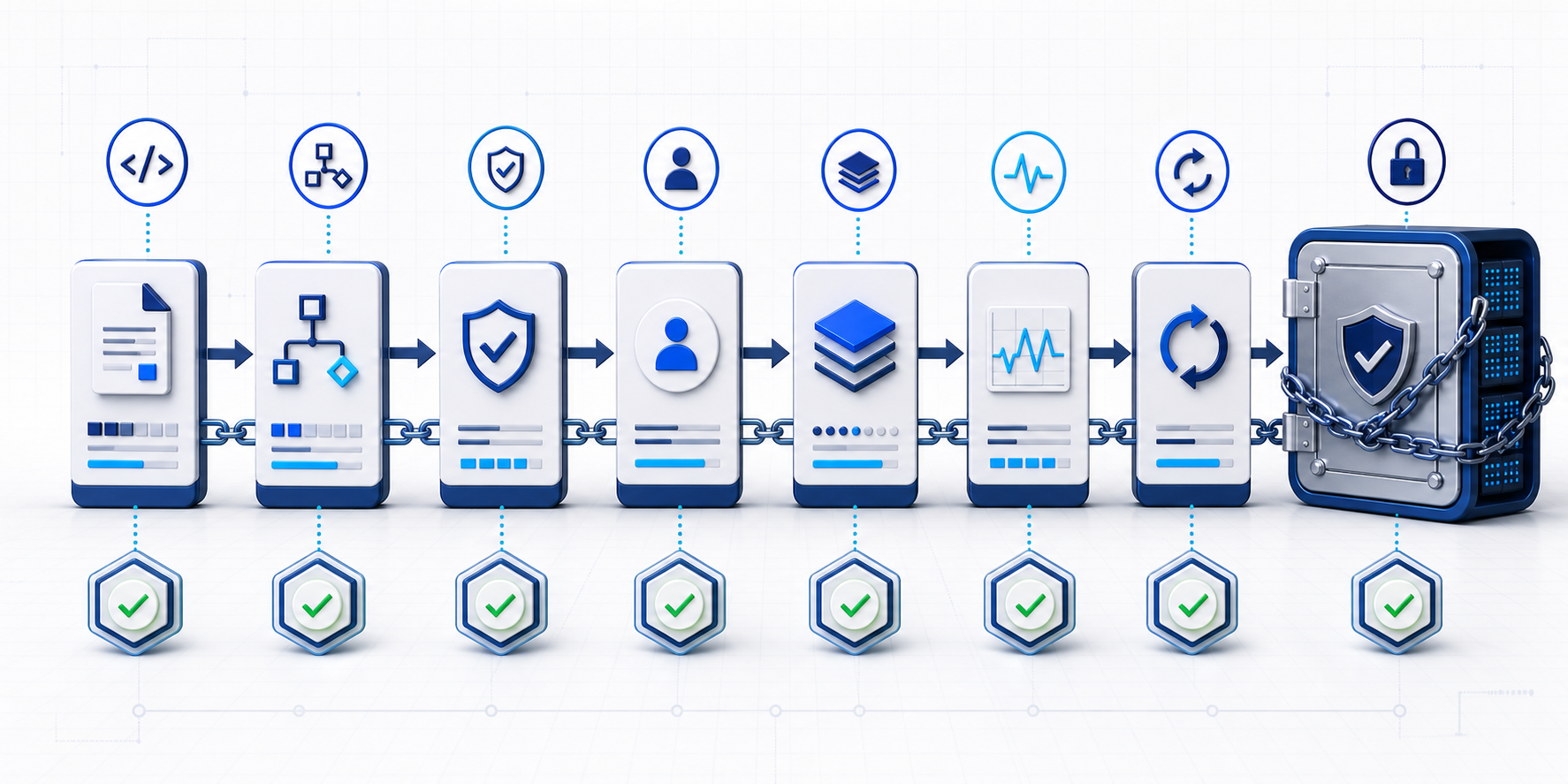
Define what the audit trail must prove
Start with operational questions, not a list of logs. Compliance teams may need evidence that production access and approvals followed policy. Engineering leaders need deployment frequency and failure patterns. Incident responders need the exact sequence of changes before a health regression. A good model supports all three without creating separate manual records.
- Authorization: the change was proposed, reviewed, and approved by permitted identities.
- Integrity: the artifact and configuration deployed are the versions that passed control gates.
- Scope: accounts, clusters, regions, services, databases, and cohorts are explicit.
- Outcome: system and customer health are connected to each rollout stage.
- Recovery: pause, rollback, or forward-fix decisions and their results are preserved.
Do not promise that a single deployment event proves success. A pipeline can return a successful status while a dependency fails, a delayed queue grows, or only one customer segment experiences errors. Evidence must include observed production outcomes.
Create one canonical change record
Assign a stable change identifier before production execution. Carry it through build metadata, deployment annotations, infrastructure operations, database migrations, telemetry markers, and incident events. This identifier becomes the join key for otherwise unrelated systems.
The canonical record should include the source revision, immutable artifact digest, work item, purpose, owner, reviewers, risk inputs, planned window, affected environments, dependency scope, rollout plan, rollback plan, and expected health signals. Store links to original evidence, but also retain essential normalized fields so queries do not depend on every source system remaining available forever.
Design rule: a person reading the record six months later should not need tribal knowledge to understand the release or its decision points.
Capture identity, approval, and policy
Record both the human initiator and the machine identity that performed each action. A deployment may be approved by an engineer, started by a workflow, and executed by a short-lived cloud role. Collapsing these identities into one “actor” hides important accountability and makes compromised automation difficult to investigate.
Approvals should contain the approver identity, time, policy evaluated, scope approved, and the exact artifact or plan under review. If the plan changes after approval, invalidate or re-evaluate the approval. Record automatic policy results with policy version, input facts, decision, and exception reference. An undocumented bypass is a gap; an explicit, time-limited exception is evidence.
- Prefer identity-provider and workload-identity identifiers over display names.
- Record role assumption and delegation chains where the platform exposes them.
- Keep separation-of-duty checks machine-readable.
- Attach emergency-change justification and post-change review requirements.
Record execution as a timeline, not a final status
A progressive release is a sequence of state transitions: artifact selected, cohort targeted, deployment started, health gate evaluated, exposure expanded, and release completed or recovered. Preserve every transition with its timestamp and scope. If the release pauses for twenty minutes, the pause is part of the evidence.
For each stage, store the intended and observed version, target count, actual count, configuration, database state, and infrastructure changes. Link health evidence such as error rate, latency, saturation, business transactions, and support signals. Record the threshold and observation window used for the decision, not only the resulting green check.
When an operator overrides an automated gate, capture the identity, rationale, previous signal, and resulting scope. The goal is not to prevent every override; it is to make exceptional decisions visible and reviewable.
Protect evidence integrity and availability
An audit trail stored beside the workload and writable by the same production role is easy to lose or alter. Send evidence to a separate control boundary with least-privilege append access. Restrict deletion, monitor retention changes, encrypt transport and storage, and test retrieval.
Use immutable artifact digests, event sequence identifiers, and cryptographic checksums where appropriate. A hash does not establish that an event is truthful, but it can help prove that stored evidence has not changed. Preserve source timestamps and ingestion timestamps so delayed delivery is distinguishable from the actual event order.
Define retention from incident, regulatory, contractual, and engineering-learning requirements. Keep sensitive request parameters or personal data out of the record unless they are required, protected, and governed. Auditability should not become uncontrolled data duplication.
Automate evidence collection at the control points
Manual forms decay under release pressure. Collect evidence automatically where decisions already occur: source merge, build signing, policy evaluation, approval, deployment controller, cloud control plane, migration runner, and observability gate. Allow engineers to add context, but do not ask them to retype facts the systems already know.
- Create the change record when a production-bound artifact is selected.
- Resolve owners, dependencies, environment, and customer exposure.
- Evaluate policies and retain both inputs and results.
- Append rollout events and health observations as stages execute.
- Close the record only after the observation window and recovery state are known.
- Reconcile source systems and alert when expected evidence is missing.
Schema version the evidence model. Integrations change, fields are renamed, and teams adopt new delivery methods. Versioning lets older records remain interpretable while collection evolves.
Make the trail useful during incidents
The best test of an audit trail is whether an on-call engineer can use it under pressure. Search should support service, environment, region, resource, owner, artifact, time window, and customer segment. The result should present a concise change timeline with links to deeper evidence.
During an incident, responders need to compare current state with intended state, find concurrent changes, identify the last healthy stage, and verify rollback readiness. Include database and infrastructure operations that may not share the application deployment pipeline. After recovery, attach incident impact, root cause, and follow-up actions to the same record.
Deployment audit trail checklist
- Every production change receives a stable, cross-system identifier.
- Source revision, artifact digest, configuration, and migration version are immutable references.
- Human, workload, and delegated identities remain distinct.
- Policy inputs, decisions, exceptions, and approvals are retained.
- Each rollout stage records intended scope, actual scope, and timestamps.
- Health gates preserve metrics, thresholds, observation windows, and decisions.
- Pause, override, rollback, and forward-fix actions include rationale and owner.
- Evidence is sent to a separate, protected retention boundary.
- Collection gaps and ingestion delays are observable.
- Engineers can retrieve a complete change timeline during an incident.
A trustworthy deployment audit trail is a production capability, not paperwork after the fact. Build it into the release path, connect it to real outcomes, and treat missing evidence as an operational signal. That creates a record engineers can act on and auditors can verify.