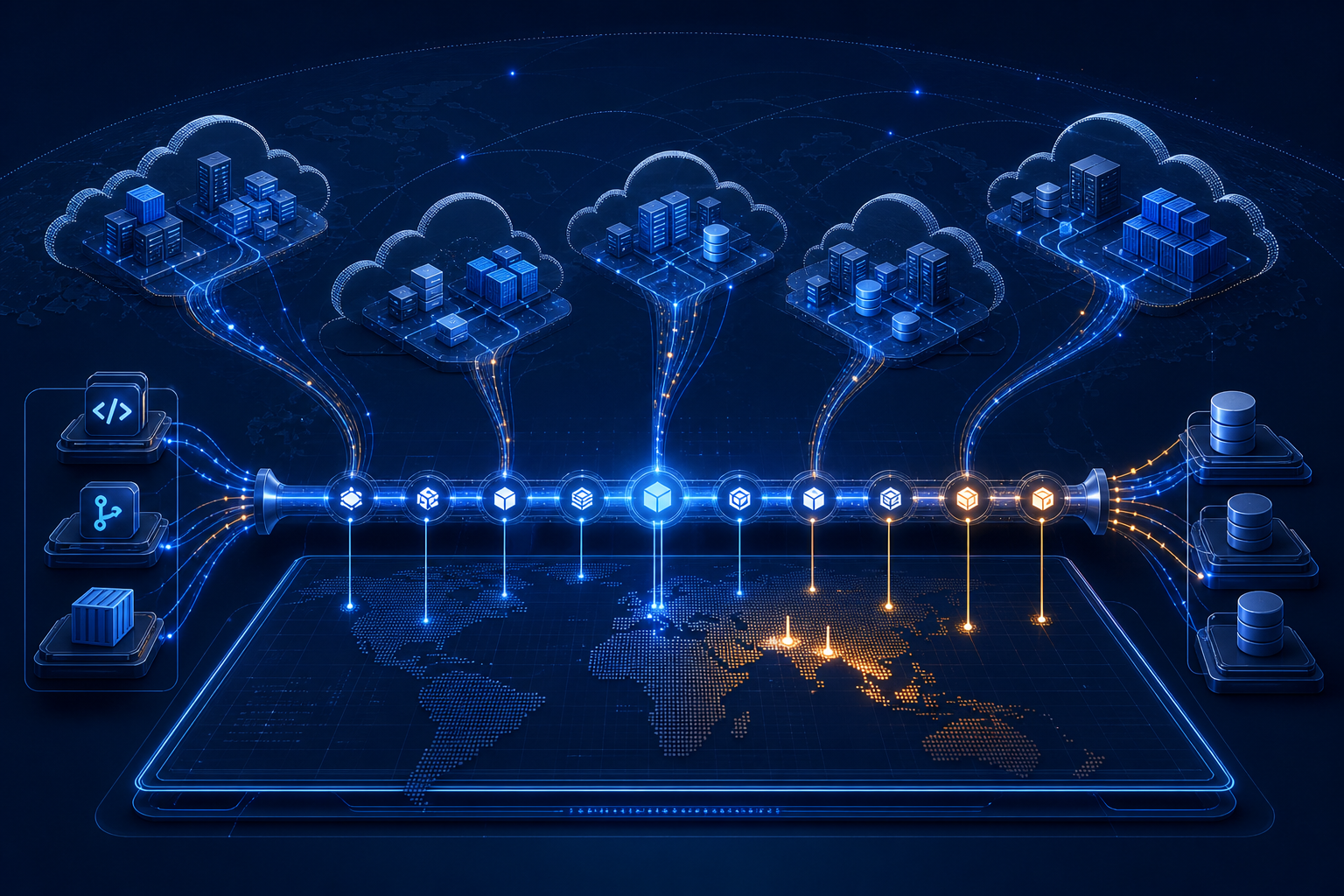
AWS production environments change through many paths: infrastructure-as-code pipelines, deployment services, console actions, automation roles, managed service control planes, and emergency operator commands. AWS CloudTrail provides essential API activity evidence, but a useful production change record needs more than an event stream.
The operational challenge is to normalize CloudTrail events, identify the real actor and resource, connect related activity to one change, and enrich it with ownership, environment, dependencies, customer exposure, and production health.
What CloudTrail contributes
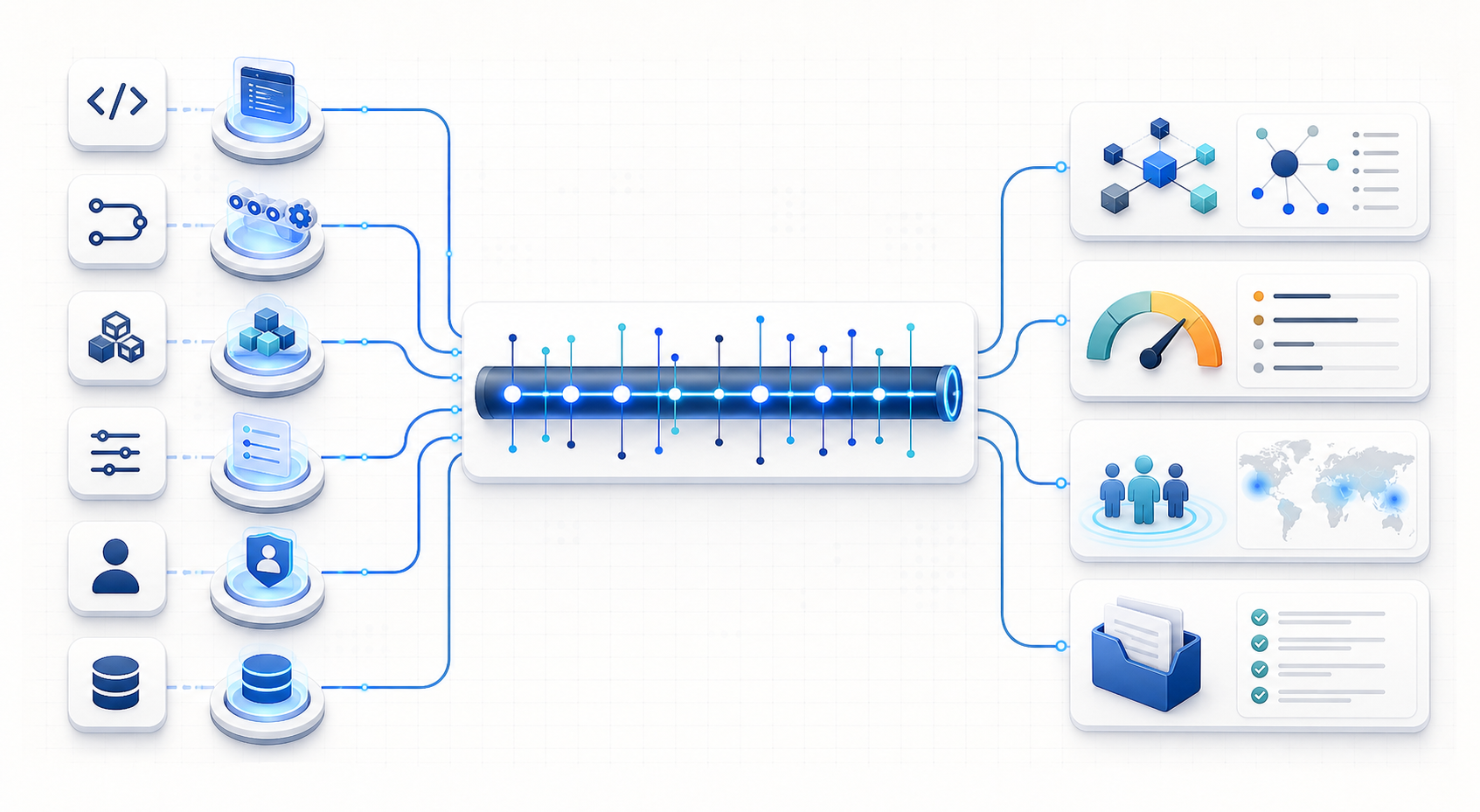
CloudTrail records supported AWS API activity and related details such as event time, service, action, region, source, identity context, request parameters, response elements, and resources where available. That makes it a strong source for answering who invoked which AWS API and when.
Important distinction: CloudTrail records activity. It does not, by itself, determine whether an event is a production change, which application owns the resource, what depends on it, which customers are exposed, or whether the outcome is healthy.
Treat CloudTrail as one evidence source inside a wider change model. AWS Config can contribute resource configuration history; infrastructure-as-code and deployment tools contribute intent; service catalogs and tags contribute ownership; CloudWatch and application telemetry contribute outcome.
Design collection coverage deliberately
For multi-account environments, establish organization-wide coverage and send logs to a controlled central destination. Include all required regions and confirm how global service events are handled. Protect the destination from production workload roles and monitor any attempt to stop logging, alter destinations, or weaken retention.
Management events cover many control-plane operations. Data events can provide object- or function-level activity for supported resources but may be high volume and require explicit selection. Choose data-event coverage from threat, audit, and operational use cases rather than enabling everything without a retention and cost model.
- Define which accounts and regions are production.
- Document trail and event-data-store coverage, retention, and expected delivery path.
- Enable higher-volume event categories only where the operational value is clear.
- Continuously test that a known API action appears in the central evidence path.
- Alert on gaps, delivery failures, and logging configuration changes.
Normalize service-specific events
Raw request parameters vary significantly between services. Build a common event envelope before classification:
- Stable event identifier and event timestamp.
- AWS account, region, service, action, event category, and read/write classification.
- Principal type, ARN, assumed-role session, source identity, and access path.
- Resource ARN or a normalized resource key derived from request and response fields.
- Source IP, user agent, error code, error message, and request identifier.
- Original event reference for forensic review without copying sensitive values into every downstream system.
Normalize identities carefully. A deployment may appear as an assumed role rather than a human. Trace role session names, source identity, session tags, workload identity, and pipeline records to the initiating system or user. Avoid attributing every action to the role’s generic name.
Add production context
Map each resource to environment, application, service, owner, criticality, data classification, and dependency relationships. Combine tags with deployment manifests, Terraform state, CloudFormation stacks, Kubernetes metadata, service catalogs, DNS, load balancer targets, and observed telemetry.
Tagging is valuable but incomplete. Tags may be missing, stale, or copied incorrectly. Preserve the source and confidence of every ownership or dependency claim, and treat missing production ownership as a risk signal.
Group events into meaningful changes
One intended change can generate hundreds of AWS API events. Showing every event as a separate deployment overwhelms operators. Correlate events using a bounded time window and stronger identifiers when available:
- Pipeline execution, deployment, stack operation, or infrastructure plan identifier.
- Assumed-role session, source identity, session tags, or automation user agent.
- Commit, release, change-request, or artifact version propagated by the delivery system.
- Shared resource hierarchy, such as a CloudFormation stack or application deployment.
- Temporal proximity, while avoiding accidental grouping of unrelated changes.
Keep the relationship between the summary and original events. Operators should see “checkout release changed five ECS resources and two target groups” and still be able to inspect each API call.
Turn evidence into an operating workflow
- Detect: ingest the event and classify whether it can alter production behavior, security, availability, cost, or data.
- Correlate: attach it to a planned release or create an unplanned-change record.
- Enrich: resolve resources, owners, environment, dependencies, related changes, and customer exposure.
- Assess: evaluate sensitive actions, scope, timing, blast radius, and recovery readiness.
- Observe: bind relevant CloudWatch and application signals to the change window.
- Respond: notify the right owner, stop expansion, restore configuration, shift traffic, or invoke the defined recovery workflow.
- Record: preserve the event evidence, decisions, health results, actions, and final outcome.
Useful high-signal categories include security group and network path changes, IAM and resource-policy modifications, database configuration or failover activity, load balancer and DNS changes, encryption and key-policy changes, logging changes, and production resource deletion.
Protect the evidence path
- Use least-privilege roles for collection and analysis.
- Separate log administration from workload administration.
- Encrypt destinations and control key use deliberately.
- Restrict deletion and retention changes, and monitor access to stored events.
- Use available integrity-validation controls where they fit the evidence design.
- Filter or protect sensitive request fields in downstream copies while retaining a governed forensic source.
- Record changes to the collection configuration as production changes themselves.
Know what the event stream cannot tell you
Not every operationally relevant action appears with the same detail or delivery timing. Resource information may be absent or embedded in service-specific parameters. Read activity and supported data events depend on configuration. A successful API response does not prove the resource reached its intended state, and CloudTrail does not measure customer health.
Validate critical assumptions against current AWS documentation and your own account configuration. Test representative operations for every production service you depend on. Combine CloudTrail with configuration state, delivery metadata, dependency context, and observability.
Effective AWS change tracking produces a concise answer during an incident: what changed, through which identity and release, which production resources and customers are in scope, whether health moved, and how the team can recover. CloudTrail provides vital evidence; production context turns that evidence into control.