
Blast radius describes the maximum scope of damage a failure or unsafe change can cause. In software engineering, that scope can include far more than the component being deployed: dependent services, shared infrastructure, data, regions, customer tenants, revenue paths, and the teams responsible for recovery.
Teams use blast radius in two related ways. Before a release, it estimates possible exposure and guides rollout controls. During an incident, it helps responders find affected systems and prioritize containment.
Blast radius is reach, not probability
A change with a broad blast radius is not automatically likely to fail. It means that if failure occurs, the potential reach is broad. Probability and blast radius should therefore remain separate inputs in a risk model.
Example: a well-tested configuration change to a shared API gateway may have low failure probability but very high blast radius. A risky code change behind a flag for one internal tenant may have high failure probability but a tightly limited blast radius.
Separating these dimensions leads to better controls. The gateway change may need redundant validation and a rapid configuration restore. The flagged change may need a small cohort and close behavioral monitoring.
Six dimensions of production impact
- Service scope: directly changed services plus upstream callers and downstream dependencies.
- Infrastructure scope: accounts, clusters, networks, queues, storage, compute, identity boundaries, and shared platform components.
- Data scope: schemas, tables, partitions, records, replicas, streams, and derived datasets.
- Geographic scope: availability zones, regions, edge locations, and data-residency boundaries.
- Customer scope: tenants, plans, user cohorts, devices, and business journeys exposed to the changed path.
- Time scope: how long effects persist, including delayed jobs, cached state, irreversible writes, and downstream reconciliation.
A useful estimate reports these dimensions instead of compressing everything into “small” or “large.” A change can be narrow by region but broad by customer, or limited to one service while affecting durable data for months.
Build a dependency model that reflects reality
Start with explicit relationships from service catalogs, infrastructure-as-code, orchestration platforms, cloud resource tags, database metadata, API gateways, and message schemas. Then enrich them with observed traffic and telemetry. Declared dependencies reveal intent; observed dependencies reveal actual runtime behavior.
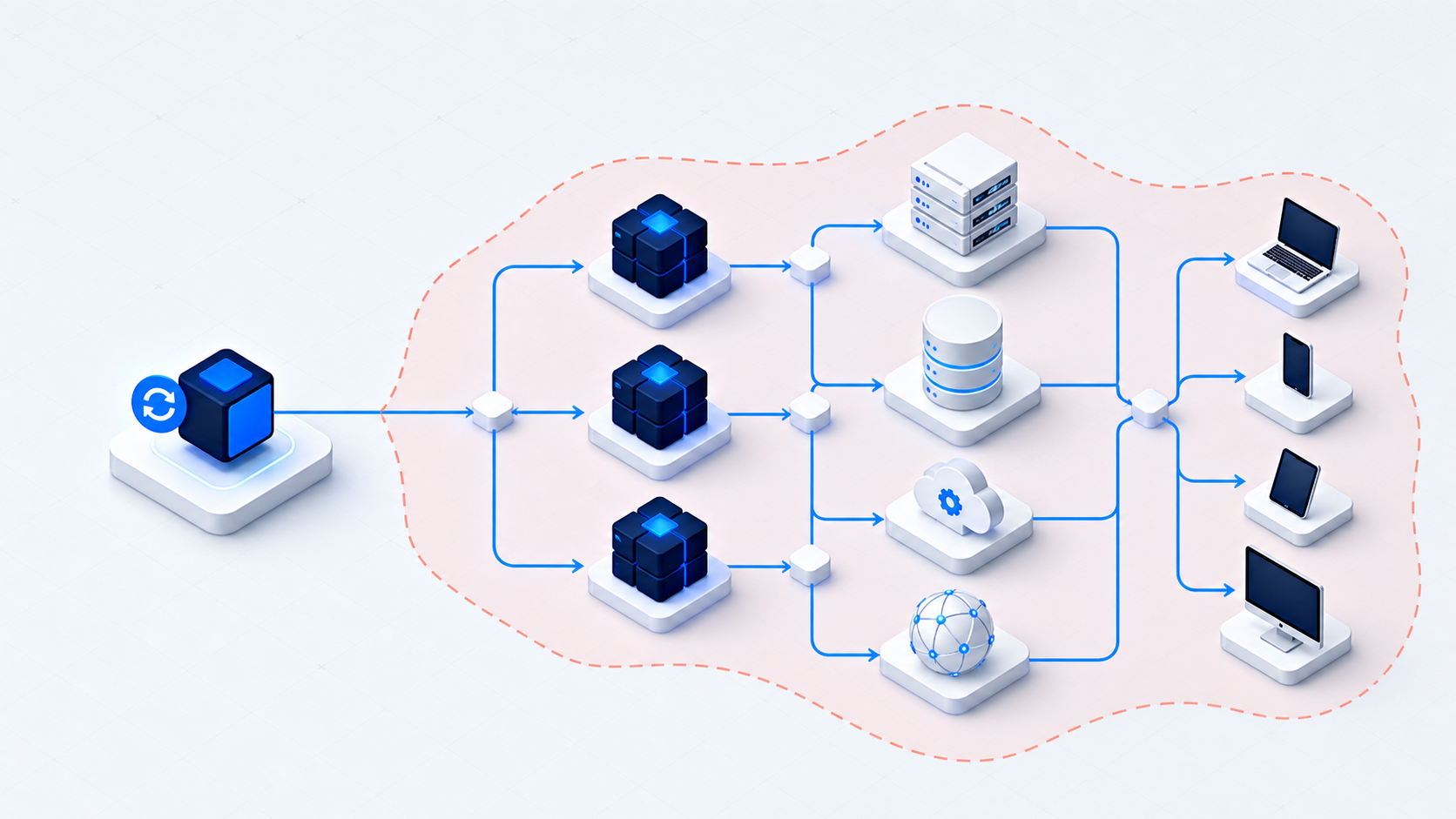
Relationships should carry metadata such as criticality, direction, protocol, environment, region, owner, and confidence. A synchronous payment call has different failure propagation from an eventually consistent analytics event. Do not treat every edge as equivalent.
How to estimate blast radius before release
- Identify the change boundary. Include application artifacts, infrastructure resources, schemas, configuration, flags, and permissions that move together.
- Traverse direct dependencies. Find immediate callers, consumers, shared resources, and data flows.
- Expand through critical paths. Continue traversal where failures can propagate synchronously, corrupt data, or block a customer journey.
- Apply release scope. Filter by the actual region, cluster, tenant cohort, traffic percentage, or feature eligibility.
- Attach business exposure. Map reachable components to customers, plans, transactions, and critical events.
- Model persistence. Determine whether stopping the release also stops the impact, or whether data and messages continue propagating.
Represent uncertainty explicitly. If ownership is missing, a relationship is stale, or runtime evidence is incomplete, lower confidence rather than silently excluding the node. Missing topology is itself a risk signal.
Techniques that reduce blast radius
Progressive delivery
Limit a release by traffic, user cohort, tenant, region, or account, then expand only after defined health gates pass. The sequence should align with failure isolation boundaries; sending 1% of global traffic through one shared database may not limit a database migration’s blast radius.
Cellular and regional isolation
Partition workloads so an unsafe change or overload cannot reach every customer. Independent cells, accounts, clusters, or regions make the architecture’s maximum failure domain smaller.
Feature controls
Decouple code deployment from feature exposure. Flags can limit behavioral change by customer or cohort, but they require ownership, expiration, dependency awareness, and a tested off path.
Compatibility and graceful degradation
Backward-compatible APIs and schemas keep old and new versions working during rollout. Timeouts, circuit breakers, rate limits, bulkheads, and fallback behavior prevent one unhealthy dependency from exhausting an entire request chain.
Blast radius changes during a release
Blast radius is not a static property of a service. A canary may begin with five internal users, expand to one region, then reach all customers. Traffic patterns, feature eligibility, concurrent changes, and dependency health can alter exposure at each stage.
Recalculate or refresh the estimate before every material expansion. A previously healthy dependency may become degraded, a critical business event may begin, or another team may introduce a related change. The go/no-go decision should use current production context.
Make blast radius operational
- Show affected services, resources, data, regions, customers, and owners in the release record.
- Use blast-radius thresholds to require smaller stages or stronger approval.
- Bind health metrics to the customer journeys and dependencies inside the predicted radius.
- Compare predicted scope with actual incident impact and repair missing graph relationships.
- Run recovery exercises that include downstream data and delayed effects, not only application rollback.
The value of blast-radius analysis is not a beautiful dependency graph. It is the ability to make a safer release decision: understand who and what can be affected, constrain that exposure deliberately, observe the right signals, and recover the entire impacted path.