
Production change management is the discipline of understanding, evaluating, controlling, and recording every material change to a live environment. It covers far more than application deployments. Infrastructure updates, database migrations, feature flag changes, identity and access modifications, configuration edits, traffic rules, and emergency remediations can all alter production behavior.
The goal is not to eliminate change or surround every release with slow meetings. The goal is to give teams enough shared context and control to move quickly without taking risks they cannot see.
A working definition
A production change is any intentional action that can modify the behavior, availability, security, cost, data integrity, or customer experience of a production system. Production change management is the operating system around those actions: how a change is detected, described, assessed, approved, released, observed, recovered, and preserved as evidence.
A useful change record answers seven questions: what changed, who owns it, where it will run, what depends on it, who may be affected, how health will be judged, and how the team will recover.
Why deployment tooling is not enough
A deployment pipeline knows how to build and move an artifact. It rarely knows that the same release includes an IAM policy change, a schema migration, a customer-specific flag, or a routing update made in another system. Each individual tool can report a successful action while the combined production outcome is unsafe.
Change management connects those fragmented events into one release context. That connection matters because operational risk usually comes from interactions: a compatible application change paired with an incompatible schema, a safe configuration deployed to the wrong region, or a normal code release made during peak traffic without rollback readiness.
- Technical context: services, resources, data stores, dependencies, versions, and environments.
- Business context: customer tenants, regions, plans, revenue flows, and critical operating periods.
- Control context: approvals, policy results, rollout stages, health gates, and recovery actions.
The production change lifecycle
A mature workflow creates a continuous evidence chain. Automation should collect facts wherever possible, while people make explicit decisions where judgment is valuable.
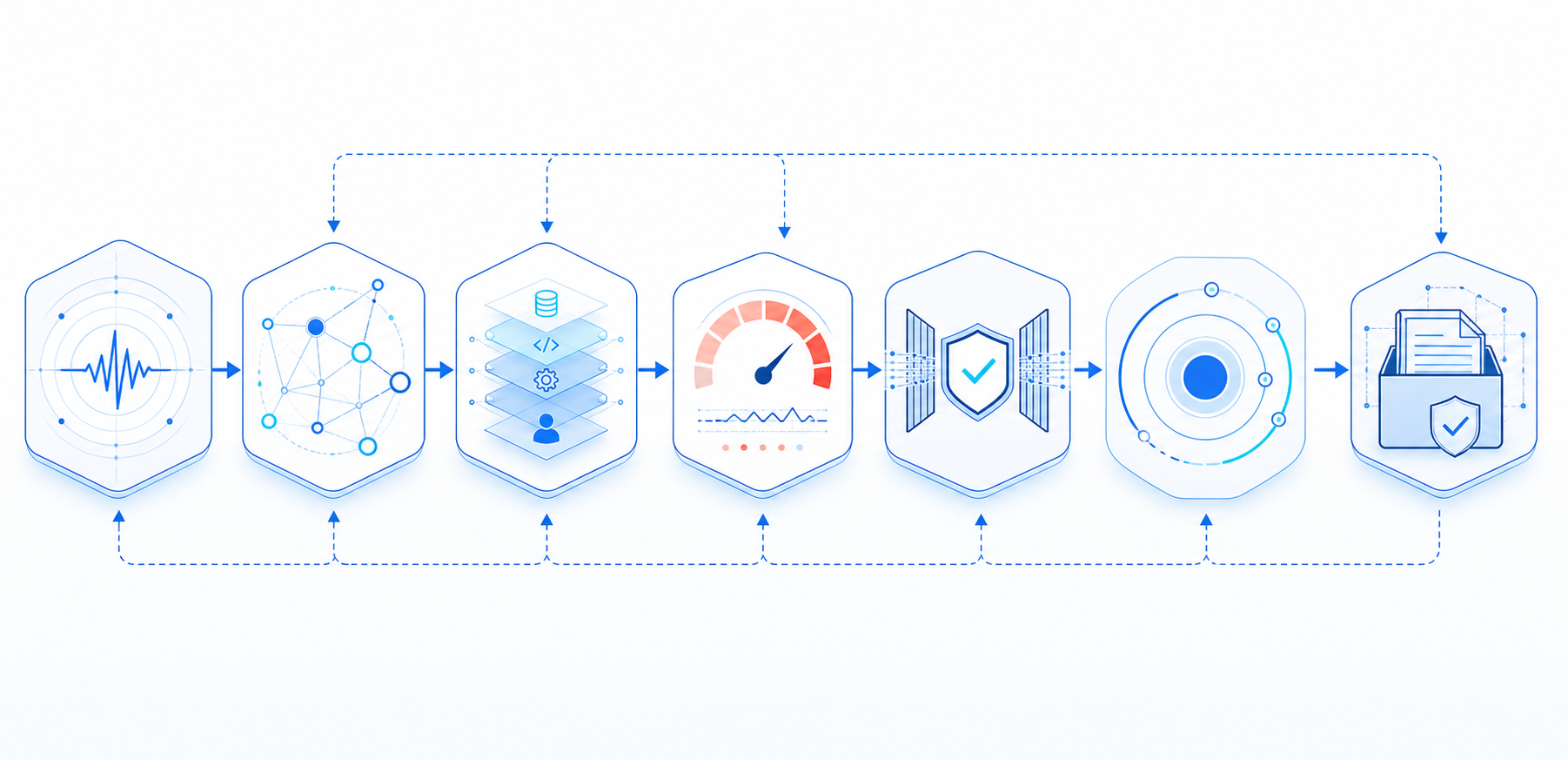
- Detect: capture planned and unplanned changes from repositories, CI/CD, cloud APIs, infrastructure-as-code systems, databases, and administrative tools.
- Enrich: add ownership, environment, dependencies, customer exposure, maintenance-window, and related-change context.
- Assess: calculate risk from evidence instead of relying only on a change label such as low, medium, or high.
- Control: apply policies, approvals, segregation of duties, and progressive rollout stages appropriate to the risk.
- Verify: evaluate technical and business health throughout the release, not only after it finishes.
- Record: preserve the inputs, decisions, actions, health results, rollback steps, and final outcome.
Core controls for safe change
Evidence-based risk assessment
Risk should reflect change scope, dependency criticality, customer exposure, timing, historical failure patterns, test evidence, observability coverage, and recovery readiness. A small configuration change to an authentication boundary may deserve more scrutiny than a large isolated code change.
Progressive exposure
Release stages limit the number of systems or customers exposed before the team has production evidence. Internal users, a small traffic percentage, selected tenants, one region, and then broader availability create multiple opportunities to stop safely.
Health gates and stop conditions
Each stage needs defined success criteria. Error rate, latency, saturation, queue depth, data consistency, conversion, payment success, and support signals may all matter. Teams should also define missing telemetry as a failure condition; the absence of evidence is not evidence of health.
Coordinated recovery
Rollback is rarely a single command. Recovery may involve shifting traffic, reverting an application, disabling a flag, restoring configuration, invalidating caches, pausing consumers, or applying a forward database repair. The recovery plan must match the whole change set.
Who owns production change management?
Platform and release engineering teams typically own the shared workflow and integrations. Service teams own change intent, health criteria, and service-specific recovery. SRE contributes reliability policy and operational thresholds. Security and compliance teams define sensitive-change controls and evidence requirements. Business owners identify critical periods and customer-impact priorities.
The healthiest model is federated: a common control plane with standards that teams can extend for their own services. A central approval board for every routine change becomes a bottleneck; completely independent service practices create blind spots at system boundaries.
Metrics that reveal whether the system works
Measure both delivery performance and control quality. A single metric can be gamed or misread, so review a balanced set over time.
- Change failure rate, segmented by change type, service, risk tier, and rollout strategy.
- Lead time from ready-for-production to verified release completion.
- Mean time to detect and mean time to recover from change-related degradation.
- Percentage of changes with identified ownership, dependency context, health criteria, and tested recovery.
- Risk prediction calibration: whether higher-scored changes actually fail more often.
- Time spent waiting for approvals compared with time spent producing useful evidence.
How to introduce the practice
- Inventory real production change sources instead of beginning with a new form.
- Normalize events into a shared record with stable identifiers for service, environment, owner, and release.
- Start with a small set of high-signal policy checks and make their evidence visible.
- Add progressive stages and explicit stop conditions to one high-value release path.
- Capture outcomes and use them to improve risk weights, policies, and recovery plans.
Production change management becomes valuable when it reduces uncertainty at decision time. It should help an engineer understand what is happening now, whether the next stage is safe, and what to do if the system degrades. When the workflow produces that clarity automatically, control and delivery speed reinforce each other.